Buy xshare.eu ?
We are moving the project
xshare.eu .
Are you interested in purchasing the domain
xshare.eu ?
domain@kv-gmbh.de · 0541-91531010
Buy xshare.eu ?
What is transpiration in biology?
Transpiration is the process by which plants absorb water through their roots and then release it into the atmosphere through small openings in their leaves called stomata. This process helps plants to regulate their temperature, transport nutrients, and maintain their shape. Transpiration also plays a role in the water cycle by returning water vapor to the atmosphere. **
How does transpiration depend on humidity?
Transpiration is the process by which water is lost from a plant through the stomata in its leaves. Humidity affects transpiration because it is the measure of water vapor in the air. When the air is dry, with low humidity, the plant will transpire more to compensate for the lack of moisture in the air. Conversely, when the air is humid, with high humidity, the plant will transpire less because the air already contains a significant amount of water vapor. Therefore, transpiration is directly influenced by the humidity of the surrounding air. **


Similar search terms for Transpiration
Top-Angebote
Products related to Transpiration:
-
Uplift Essentials Vocal Link Interactive Pet Communication Buttons purple"Break the language barrier between you and your pet with the VocalLink Dog Communication Buttons. This innovative pet training buzzer system allows your dog or cat to ""speak"" their needs by pressing a button that plays your prerecorded voice...."34,97 $*Shipping: 0,00 $Secure redirect to the provider
-
TP-LINK Managed Network Switch 5-Port Gigabit, Support QoS VLAN IGMP Snooping, Network Monitoring through Web Interface, 2.82 W, NewThis item offers easy setup through a web-based user interface and management utility. It is a 5-port RJ45 network switch with speeds of 10/100/1000Mbps, equipped with network monitoring, traffic prioritization, and VLAN capabilities. Additionally, it supports useful features like port mirroring, IGMP snooping, loop prevention, and Link aggregation. Quality of Service (QoS) is also supported, allowing for port-based/802.1p/DSCP priority, rate limiting, and storm control. Moreover, it incorporates energy-efficient technology, which can reduce power consumption by up to 57 percent.18,99 £*Shipping: 0,00 £Secure redirect to the provider
-
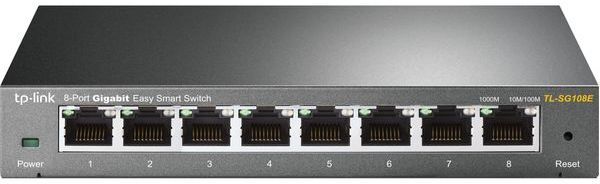
TP-LINK TL-SG108E 8-Port Gigabit Easy Smart Network Switch – Managed Desktop Ethernet SwitchOverview The TP-Link TL-SG108E 8-Port Gigabit Easy Smart Network Switch is a reliable and efficient networking solution designed for small offices, home networks, and workstations. Featuring 8 Gigabit Ethernet ports , this switch provides fast and stable wired connections for computers, printers, IP cameras, gaming consoles, and other network devices. With Easy Smart management features , including VLAN, QoS, and network monitoring, it allows users to optimise network performance while maintaining simple configuration. Built with a durable metal casing and plug-and-play functionality, the TL-SG108E offers dependable network expansion and high-speed connectivity. Key Features 8 Gigabit Ethernet Ports – High-speed wired connections for multiple network devices. Easy Smart Management – Supports VLAN, QoS, IGMP Snooping, and network monitoring features. Plug-and-Play Setup – Simple installation without complex configuration. Gigabit Speeds – Up to 1000Mbps for fast data transfer and network performance. Quality of Service (QoS) – Prioritise network traffic for smooth streaming and gaming. VLAN Support – Improved network segmentation and security. Durable Metal Housing – Robust build designed for long-term reliability. Energy Efficient Design – Automatically adjusts power consumption based on connection status. Fanless Operation – Silent performance suitable for office or home environments. Compact Desktop Design – Ideal for small networking setups. Benefits The TP-Link TL-SG108E is ideal for expanding wired networks while maintaining reliable and high-speed performance. With Gigabit connectivity , it supports smooth data transfer for bandwidth-intensive tasks such as video streaming, file sharing, and online gaming. The Easy Smart management features allow users to optimise network traffic and improve overall network efficiency. Functions such as VLAN segmentation and QoS prioritisation help ensure stable and secure connectivity across connected devices. Its compact, fanless design ensures quiet operation, making it suitable for home offices and workspaces where minimal noise is preferred. With durable metal construction and simple plug-and-play installation, the TL-SG108E provides dependable networking performance with minimal maintenance. Specifications Specification Details Brand TP-Link Model TL-SG108E EAN / Barcode [Ean] Type Easy Smart Gigabit Network Switch Ports 8 × Gigabit Ethernet Ports Switching Capacity 16 Gbps Forwarding Rate 11.9 Mpps Management Features VLAN, QoS, IGMP Snooping, Monitoring Connectivity Ethernet Mounting Desktop Housing Material Metal Cooling Fanless Power Supply External Power Adapter Dimensions Approx. 158 × 101 × 25 mm Weight Approx. 0.46 kg Package Contents TP-Link TL-SG108E Switch, Power Adapter, Installation Guide28,98 £*Shipping: 0,00 £Secure redirect to the provider
-
Pavilion Sharing with the Dog Silicone Snack BowlMake snack time more fun with this pet-inspired silicone snack bowl featuring a playful dog illustration and humorous sentiment. Durable, portable, and designed with a secure lid, it's perfect for enjoying snacks at home, work, school, or on the go21,94 $*Shipping: 0,00 $Secure redirect to the provider



-
What does a transpiration diagram look like?
A transpiration diagram typically shows the movement of water through a plant, from the roots to the leaves, and its subsequent release into the atmosphere through the process of transpiration. It often includes arrows to indicate the direction of water flow, as well as labels to identify the different parts of the plant involved in transpiration, such as roots, stem, and leaves. The diagram may also include annotations to explain the role of stomata in regulating transpiration and the factors that influence the rate of water loss. **
-
What is the significance of transpiration for plants?
Transpiration is essential for plants as it helps in the absorption of water and nutrients from the soil through the roots. It also helps in maintaining the plant's temperature by cooling the leaves through the process of evaporation. Additionally, transpiration plays a crucial role in the transportation of minerals and nutrients from the roots to the leaves and other parts of the plant. Overall, transpiration is vital for the overall health and growth of plants. **
-
Why do dead hair reduce transpiration in plants?
Dead hair reduces transpiration in plants because it forms a protective layer over the surface of the plant, reducing the rate of water loss through transpiration. This layer of dead hair acts as a barrier, preventing excessive water loss and helping the plant to conserve water in dry or arid conditions. Additionally, dead hair can also provide insulation, reducing the impact of environmental factors such as wind and sun exposure, which can further reduce transpiration. Overall, dead hair plays a crucial role in helping plants adapt and survive in challenging environmental conditions. **
-
How can an experiment on plant transpiration be conducted?
An experiment on plant transpiration can be conducted by setting up a simple apparatus called a potometer. This apparatus consists of a plant stem inserted into a capillary tube filled with water, allowing you to measure the rate of water uptake by the plant. By controlling factors such as light intensity, temperature, and humidity, you can observe how these variables affect the rate of transpiration in the plant. By recording the changes in water level in the capillary tube over time, you can calculate the rate of transpiration and draw conclusions about the factors influencing this process. **


How can the transpiration process in plants be investigated?
The transpiration process in plants can be investigated through several methods. One common method is to use a potometer, which measures the rate of water uptake by a plant. By measuring the change in water level in the potometer over time, the rate of transpiration can be calculated. Another method is to use a gas analyzer to measure the rate of water vapor loss from the leaves of a plant. Additionally, researchers can use isotopic labeling techniques to track the movement of water through the plant and determine the rate of transpiration. These methods provide valuable insights into the transpiration process and its role in plant physiology. **
How can one conduct an experiment on plant transpiration?
To conduct an experiment on plant transpiration, one can set up a simple experiment using potted plants, plastic bags, a scale, and a ruler. Start by placing a potted plant in a plastic bag and sealing it tightly. Leave the plant in a well-lit area for a set period of time, such as 24 hours. Weigh the plant before and after the experiment to measure the amount of water lost through transpiration. Use the ruler to measure the surface area of the leaves to calculate the rate of transpiration. **
Top-Angebote
Products related to Transpiration:
-
All Categories Goods Outdoor Library Box Wooden Book Exchange Cabinet For Neighborhood Sharing Outdoor Library Box Wooden Book Exchange Cabinet For Neighborhood SharingCreate a welcoming place where stories can be shared, discovered, and loved again. This outdoor library box is a charming wooden cabinet made for neighborhoods, schools, parks, gardens, and front yards. Designed as a book exchange box, it gives...199,97 $*Shipping: 0,00 $Secure redirect to the provider
-
TP-LINK UE300C USB-C to Ethernet Adapter – Gigabit Connectivity for Ultrabooks & TabletsOverview: The TP-Link UE300C is a compact and efficient USB-C to Gigabit Ethernet adapter, designed to provide high-speed wired internet access to devices lacking an Ethernet port. Ideal for ultrabooks, Chromebooks, and tablets, it ensures stable and fast network connections. Product Description: This lightweight adapter features a USB 3.0 Type-C connector and an RJ45 Gigabit Ethernet port, supporting data transfer speeds up to 1000Mbps. Its plug-and-play functionality ensures easy setup without the need for additional drivers on most operating systems, including Windows 10/8.1/8/7, macOS 10.9 and later, Chrome OS, and Linux. The foldable design enhances portability, making it an excellent companion for on-the-go professionals. Key Features: High-Speed Connectivity: Supports Gigabit Ethernet speeds up to 1000Mbps for seamless streaming, gaming, and large file transfers. Plug-and-Play: No additional drivers required for most operating systems; compatible with Windows, macOS, Chrome OS, and Linux. Compact Design: Slim and foldable, perfect for travel and easy storage. Universal Compatibility: Works with a wide range of USB-C devices, including ultrabooks, tablets, and smartphones. Durable Build: Designed for reliable performance and longevity.9,99 £*Shipping: 0,00 £Secure redirect to the provider
-
Uplift Essentials Vocal Link Interactive Pet Communication Buttons purple"Break the language barrier between you and your pet with the VocalLink Dog Communication Buttons. This innovative pet training buzzer system allows your dog or cat to ""speak"" their needs by pressing a button that plays your prerecorded voice...."34,97 $*Shipping: 0,00 $Secure redirect to the provider
-
TP-LINK Managed Network Switch 5-Port Gigabit, Support QoS VLAN IGMP Snooping, Network Monitoring through Web Interface, 2.82 W, NewThis item offers easy setup through a web-based user interface and management utility. It is a 5-port RJ45 network switch with speeds of 10/100/1000Mbps, equipped with network monitoring, traffic prioritization, and VLAN capabilities. Additionally, it supports useful features like port mirroring, IGMP snooping, loop prevention, and Link aggregation. Quality of Service (QoS) is also supported, allowing for port-based/802.1p/DSCP priority, rate limiting, and storm control. Moreover, it incorporates energy-efficient technology, which can reduce power consumption by up to 57 percent.18,99 £*Shipping: 0,00 £Secure redirect to the provider
-
What is transpiration in biology?
Transpiration is the process by which plants absorb water through their roots and then release it into the atmosphere through small openings in their leaves called stomata. This process helps plants to regulate their temperature, transport nutrients, and maintain their shape. Transpiration also plays a role in the water cycle by returning water vapor to the atmosphere. **
-
How does transpiration depend on humidity?
Transpiration is the process by which water is lost from a plant through the stomata in its leaves. Humidity affects transpiration because it is the measure of water vapor in the air. When the air is dry, with low humidity, the plant will transpire more to compensate for the lack of moisture in the air. Conversely, when the air is humid, with high humidity, the plant will transpire less because the air already contains a significant amount of water vapor. Therefore, transpiration is directly influenced by the humidity of the surrounding air. **
-
What does a transpiration diagram look like?
A transpiration diagram typically shows the movement of water through a plant, from the roots to the leaves, and its subsequent release into the atmosphere through the process of transpiration. It often includes arrows to indicate the direction of water flow, as well as labels to identify the different parts of the plant involved in transpiration, such as roots, stem, and leaves. The diagram may also include annotations to explain the role of stomata in regulating transpiration and the factors that influence the rate of water loss. **
-
What is the significance of transpiration for plants?
Transpiration is essential for plants as it helps in the absorption of water and nutrients from the soil through the roots. It also helps in maintaining the plant's temperature by cooling the leaves through the process of evaporation. Additionally, transpiration plays a crucial role in the transportation of minerals and nutrients from the roots to the leaves and other parts of the plant. Overall, transpiration is vital for the overall health and growth of plants. **
Similar search terms for Transpiration
-
TP-LINK TL-SG108E 8-Port Gigabit Easy Smart Network Switch – Managed Desktop Ethernet SwitchOverview The TP-Link TL-SG108E 8-Port Gigabit Easy Smart Network Switch is a reliable and efficient networking solution designed for small offices, home networks, and workstations. Featuring 8 Gigabit Ethernet ports , this switch provides fast and stable wired connections for computers, printers, IP cameras, gaming consoles, and other network devices. With Easy Smart management features , including VLAN, QoS, and network monitoring, it allows users to optimise network performance while maintaining simple configuration. Built with a durable metal casing and plug-and-play functionality, the TL-SG108E offers dependable network expansion and high-speed connectivity. Key Features 8 Gigabit Ethernet Ports – High-speed wired connections for multiple network devices. Easy Smart Management – Supports VLAN, QoS, IGMP Snooping, and network monitoring features. Plug-and-Play Setup – Simple installation without complex configuration. Gigabit Speeds – Up to 1000Mbps for fast data transfer and network performance. Quality of Service (QoS) – Prioritise network traffic for smooth streaming and gaming. VLAN Support – Improved network segmentation and security. Durable Metal Housing – Robust build designed for long-term reliability. Energy Efficient Design – Automatically adjusts power consumption based on connection status. Fanless Operation – Silent performance suitable for office or home environments. Compact Desktop Design – Ideal for small networking setups. Benefits The TP-Link TL-SG108E is ideal for expanding wired networks while maintaining reliable and high-speed performance. With Gigabit connectivity , it supports smooth data transfer for bandwidth-intensive tasks such as video streaming, file sharing, and online gaming. The Easy Smart management features allow users to optimise network traffic and improve overall network efficiency. Functions such as VLAN segmentation and QoS prioritisation help ensure stable and secure connectivity across connected devices. Its compact, fanless design ensures quiet operation, making it suitable for home offices and workspaces where minimal noise is preferred. With durable metal construction and simple plug-and-play installation, the TL-SG108E provides dependable networking performance with minimal maintenance. Specifications Specification Details Brand TP-Link Model TL-SG108E EAN / Barcode [Ean] Type Easy Smart Gigabit Network Switch Ports 8 × Gigabit Ethernet Ports Switching Capacity 16 Gbps Forwarding Rate 11.9 Mpps Management Features VLAN, QoS, IGMP Snooping, Monitoring Connectivity Ethernet Mounting Desktop Housing Material Metal Cooling Fanless Power Supply External Power Adapter Dimensions Approx. 158 × 101 × 25 mm Weight Approx. 0.46 kg Package Contents TP-Link TL-SG108E Switch, Power Adapter, Installation Guide28,98 £*Shipping: 0,00 £Secure redirect to the provider
-
Pavilion Sharing with the Dog Silicone Snack BowlMake snack time more fun with this pet-inspired silicone snack bowl featuring a playful dog illustration and humorous sentiment. Durable, portable, and designed with a secure lid, it's perfect for enjoying snacks at home, work, school, or on the go21,94 $*Shipping: 0,00 $Secure redirect to the provider
-
Pfaltzgraff Winterberry 12In Family and Friends Sharing PlateCelebrate all through the season with a Winterberry 'Family and Friends Plate of Sharing' plate Serveware is ideal for entertaining and serving Platter has a creamy background with delicately rendered holly branches31,49 $*Shipping: 0,00 $Secure redirect to the provider
-
Uplift Essentials Vocal Link Interactive Pet Communication Buttons blue"Break the language barrier between you and your pet with the VocalLink Dog Communication Buttons. This innovative pet training buzzer system allows your dog or cat to ""speak"" their needs by pressing a button that plays your prerecorded voice...."34,97 $*Shipping: 0,00 $Secure redirect to the provider
-
Why do dead hair reduce transpiration in plants?
Dead hair reduces transpiration in plants because it forms a protective layer over the surface of the plant, reducing the rate of water loss through transpiration. This layer of dead hair acts as a barrier, preventing excessive water loss and helping the plant to conserve water in dry or arid conditions. Additionally, dead hair can also provide insulation, reducing the impact of environmental factors such as wind and sun exposure, which can further reduce transpiration. Overall, dead hair plays a crucial role in helping plants adapt and survive in challenging environmental conditions. **
-
How can an experiment on plant transpiration be conducted?
An experiment on plant transpiration can be conducted by setting up a simple apparatus called a potometer. This apparatus consists of a plant stem inserted into a capillary tube filled with water, allowing you to measure the rate of water uptake by the plant. By controlling factors such as light intensity, temperature, and humidity, you can observe how these variables affect the rate of transpiration in the plant. By recording the changes in water level in the capillary tube over time, you can calculate the rate of transpiration and draw conclusions about the factors influencing this process. **
-
How can the transpiration process in plants be investigated?
The transpiration process in plants can be investigated through several methods. One common method is to use a potometer, which measures the rate of water uptake by a plant. By measuring the change in water level in the potometer over time, the rate of transpiration can be calculated. Another method is to use a gas analyzer to measure the rate of water vapor loss from the leaves of a plant. Additionally, researchers can use isotopic labeling techniques to track the movement of water through the plant and determine the rate of transpiration. These methods provide valuable insights into the transpiration process and its role in plant physiology. **
-
How can one conduct an experiment on plant transpiration?
To conduct an experiment on plant transpiration, one can set up a simple experiment using potted plants, plastic bags, a scale, and a ruler. Start by placing a potted plant in a plastic bag and sealing it tightly. Leave the plant in a well-lit area for a set period of time, such as 24 hours. Weigh the plant before and after the experiment to measure the amount of water lost through transpiration. Use the ruler to measure the surface area of the leaves to calculate the rate of transpiration. **
* All prices are inclusive of VAT and, if applicable, plus shipping costs. The offer information is based on the details provided by the respective shop and is updated through automated processes. Real-time updates do not occur, so deviations can occur in individual cases. ** Note: Parts of this content were created by AI.